
Persons
8
Preparation time
Difficulty
Cost
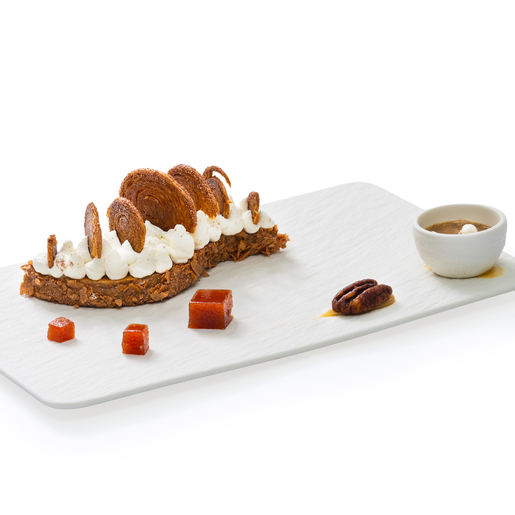

Recipe created by :
Christophe Pélerbe, Baker Expert France

Moments of consumption :
Breakfast
Snack
Dinner
Lunch
Brunch
Aperitif
Recipe made with :


List of ingredients
- Croissants 30 g: 16 to 28 pieces (depending on the required format)
- Crispy croissant base
- Butter: 100 g
- Croissant and or/crispy biscuit: 200 g
- Quince
- Quince jam: 200 g
- Sugar: 12 g
- Pectin: 1.5 g
- Praline & dried fruits
- Dried fruit praline: 250 g
- Pecan nuts: 200 g
- Sugar: 150 g
- Chocolate
- Caramel milk chocolate: 125 g
- White chocolate: 50 g
- Cream & dairy products
- Cream (35% fat): 353 g
- Cream (for whipped ganache): 250 g
- Milk: 26 g
- Butter (caramel): 43 g
- Caramel
- Glucose: 86 g
- Sugar: 43 g
- Flavours & finishing details
- Vanilla: 0.5 g
- Ground yuzu: 3 g
- Icing sugar (QS)
- Decorative sugar (QS)

Preparation steps
Prior preparation
- Fold 8 sheets of 40 × 60 cm baking paper three times lengthwise.
- Cut each fold with a knife to obtain 64 small sheets measuring 15 × 20 cm (i.e. 8 small sheets per 40 × 60 sheet).
- Set aside
Making the clarified butter
- Use 100 g of butter (salted or unsalted)
- Make a clarified butter.
- Keep it at room temperature in a small bain-marie of hot water in order to keep it liquid and ready to use.
Making the "flat" croissants
- Use 12 croissants if you want to cut out 2 very thin "S" shapes per flat croissant, or 24 croissants if you want to cut out a single, slightly less thin "S" shape per flat croissant. The final objective is to have 3 "S" per individual dessert.
- Arrange the quantity of croissants chosen on a 40 x 60 cm tray covered with baking paper.
- Allow to defrost at room temperature for 30 to 45 minutes.
- Prepare twice as many small sheets (15 x 20 cm) as the number of croissants used: 24 small sheets for 12 croissants, 48 small sheets for 24 croissants.
- Using a brush, finely coat one side of each small sheet with the liquid clarified butter.
- Centre each croissant on as many small, buttered sheets as necessary, placing the length of the croissant along the length of the sheet.
- Cover each croissant with a small, buttered sheet, keeping the same lengthwise orientation and placing the buttered side in contact with the croissant.
- Using a small, thick, flat, straight chopping board, flatten each croissant firmly and individually between the two sheets until it is about 2 to 3 mm thick.
- Using a rolling pin, finish flattening: adjust the length, width and above all the evenness of the thickness, depending on the number of "S" shapes required per croissant.
- Put a maximum of 8 flat croissants, still between their small sheets, on a perfectly flat 40 x 60 aluminium tray lined with baking paper.
- Ensure that the croissants do not overlap.
- Cover with a large sheet of 40 x 60 cm baking paper, then with a perfectly flat aluminium sheet of the same size, then with 3 to 5 wire racks, depending on their weight, to create a load. This load will ensure that the croissants remain perfectly flat while they bake.
Making the croissant arlettes
- Use 4 croissants for the arlettes.
- Take the croissants out of the freezer one by one.
- Without delay, cut each croissant into 10 to 14 slices of the required thickness using a wide and very sharp knife (like a Santoku knife).
- Immediately place each slice flat on a perfectly flat aluminium tray lined with baking paper.
- Arrange neatly and orderly, leaving enough space between slices to prevent them from sticking together.
- Sprinkle each slice with a fine dusting of icing sugar.
- Cover the whole tray with a sheet of baking paper, then a perfectly flat aluminium tray. It is not necessary to add racks: the tray will be enough to keep the arlettes flat.
Baking the flat croissants
- Preheat the oven to 180°C.
- Put in the oven, then immediately lower the temperature to 155°C.
- After 8 minutes of baking (white to lightly browned), remove all the trays, remove the racks and cover plate, remove the large sheet and small top sheets.
- While still warm, quickly cut out 1 or 2 "S" shapes per flat croissant using the "S"-shaped cookie cutter, applying simple manual pressure.
- Then cover the cut-out "S" shapes only with the large sheet of baking paper that was previously removed.
- Cover again with the aluminium tray, then return to the oven for a further 5 to 6 minutes at 155°C to finish baking and to achieve a golden colour.
Baking the arlettes
- Bake for no more than 12 to 13 minutes, until golden.
- Remove the cover plate immediately after baking to stop the cooking process.
Making use of flat croissant scraps
- Keep the scraps from cutting the "S" shapes. They will be coarsely crushed when cold to obtain pieces.
- These pieces are used to make the chocolate croustillant and for masking when assembling desserts.
Assembling the dessert.
- Arrange the 8 praline croustillants in an "S" shape while still frozen on the work surface, positioned so that the "S" shape is clearly visible, still between their two small sheets.
- Remove the top sheet from each croustillant.
- Coat each croustillant with a thin layer of pecan praline.
- Cover with a first "S" of flat croissant.
- Coat again with a thin layer of pecan praline.
- Cover with a second "S" of flat croissant.
- Coat this second "S" with the 100 g of quince jam that was put to one side.
- Cover with the third and final "S" of flat croissant.
- Using a small brush, carefully cover the entire edge of the assembly with praline, without covering the surface of the final "S".
- Cover this thin layer of praline with the flat croissant feuilletine, previously mixed with copper-coloured sugar for a sparkling effect.
- On the surface of the final "S", using a piping bag with a 5 mm straight nozzle, pipe a first line of cold, smooth caramel, following the curve of the "S" precisely.
- Repeat using shorter lines on either side of the first one, so that more caramel is concentrated towards the centre of the assembly.
- Using a 3 mm straight nozzle, pipe the whipped ganache over the entire surface, alternating between irregular peaks in size and volume.
- If desired, sprinkle the arlettes with copper-coloured sugar around the edges to give them a shiny finish.
- Arrange 5 to 7 arlettes vertically per dessert, from the smallest at each end to the largest in the centre, perpendicular to the axis of the "S", to create a three-dimensional wave inspired by the line of the croissant.